How Regional Data Center Expansions Are Altering Latency Thresholds for Real-Time Multiplayer Table Experiences Across Licensed Platforms
Felix Bennett · Jul 12, 2026

How Regional Data Center Expansions Are Altering Latency Thresholds for Real-Time Multiplayer Table Experiences Across Licensed Platforms
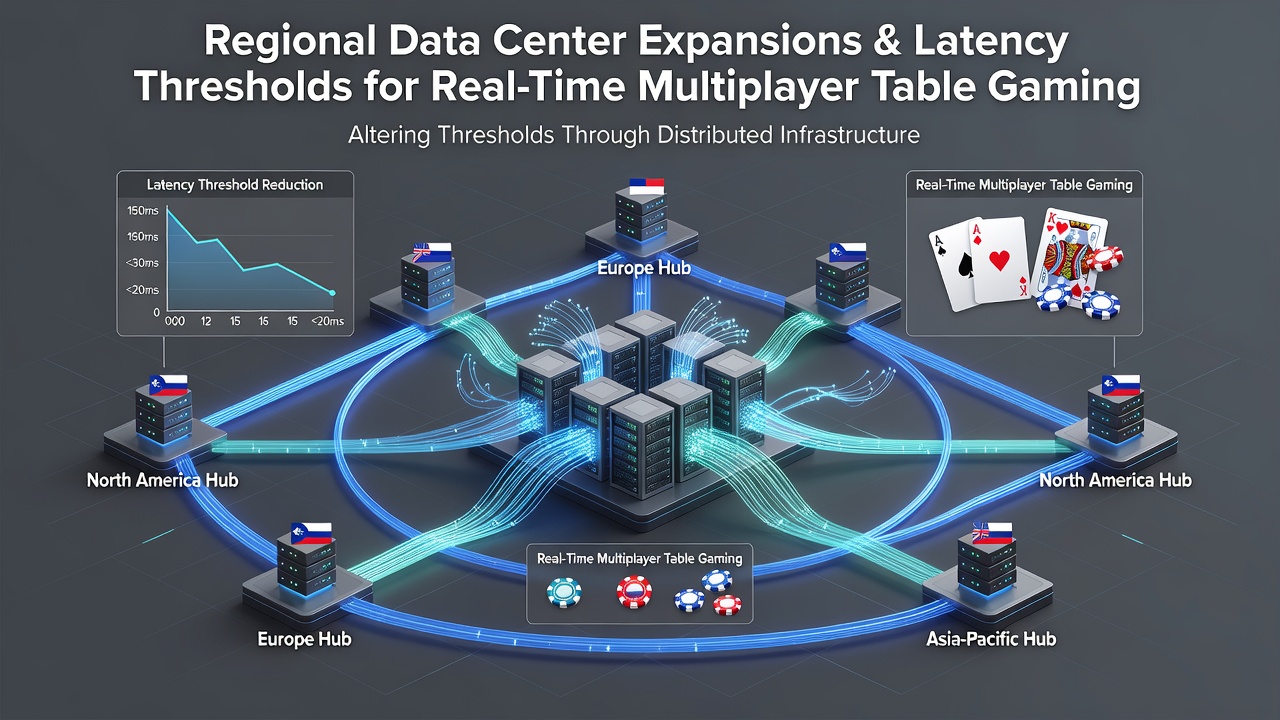
Regional data center expansions have shifted latency thresholds for real-time multiplayer table experiences on licensed platforms through closer proximity of servers to end users and improved interconnectivity between regional nodes. Operators in North America and parts of Europe have reported measurable reductions in round-trip times for actions such as card reveals and bet placements since new facilities came online between 2024 and 2026.
Latency Requirements in Licensed Multiplayer Table Environments
Real-time table games on licensed platforms require consistent sub-40 millisecond response windows to maintain synchronization across multiple participants during live dealer sessions and peer-to-peer formats. Data indicates that expansions by major cloud providers have placed additional capacity within 150 kilometers of major population centers in states like New Jersey and Pennsylvania while similar builds occurred near major European hubs.
Those who monitor network performance note that earlier thresholds often hovered near 60 milliseconds in secondary markets, whereas newer regional nodes have compressed that figure for a growing share of traffic. Licensed operators have adjusted game engines accordingly, allowing simultaneous handling of larger player pools without introducing perceptible delays during peak evening hours.
Expansion Patterns Across Key Regions
North American expansions have focused on secondary markets outside primary coastal clusters, with new facilities supporting traffic from both regulated mobile apps and desktop clients. In July 2026 several mid-Atlantic sites reached full operational status, connecting directly to existing backbone routes that serve licensed gaming traffic. European builds have emphasized cross-border fiber links that reduce handoff times between national regulatory zones, while Australian projects have targeted inland connectivity to serve remote player bases.
Observers tracking these developments point to coordinated investments by hyperscale providers alongside specialized gaming cloud services. The result has been a redistribution of traffic loads that previously routed through distant primary hubs, producing lower jitter values during high-volume table sessions.
Technical Adjustments on Licensed Platforms
Platform operators have updated edge caching rules and predictive prefetching for table state data to align with the new latency baselines. Research indicates that synchronization protocols now operate with tighter tolerance bands, enabling smoother integration of live video feeds alongside player inputs. Some platforms have introduced regional matchmaking layers that route participants to the nearest available table instance rather than a centralized server pool.
Those who have examined certification documentation note that testing regimens now include explicit latency benchmarks tied to specific geographic zones. Regulators in multiple jurisdictions have incorporated these metrics into ongoing compliance reviews, requiring operators to demonstrate that session data remains within acceptable bounds even during simulated regional outages.
Player Experience Metrics and Platform Data
Session telemetry collected across licensed environments shows reduced instances of action queuing in multiplayer table titles since regional capacity increases took effect. Figures reveal that average decision windows for games such as blackjack and poker variants have stabilized, with fewer interruptions attributed to network variability. Platforms have also reported higher concurrent user counts per table without corresponding increases in reported desync events.
According to a 2025 industry report from the European Gaming and Betting Association, cross-regional traffic optimization contributed to measurable improvements in session continuity metrics for participating operators. Similar patterns appear in North American state-level summaries published by gaming control boards, where operators documented shorter average response intervals after new data center connections activated.
Regulatory and Certification Implications
Licensing bodies have begun referencing updated latency standards when reviewing new game submissions and platform modifications. Certification laboratories now incorporate region-specific test scenarios that simulate traffic patterns across expanded data center footprints. This approach ensures that approved titles maintain consistent performance regardless of where players access the platform.
Multi-state compacts in the United States have referenced these infrastructure changes when harmonizing technical requirements, while equivalent discussions continue in European regulatory forums. The result has been a more uniform set of expectations for real-time table performance across jurisdictions that share player traffic.
Conclusion
Regional data center expansions continue to redefine acceptable latency thresholds for real-time multiplayer table experiences on licensed platforms through infrastructure changes that bring processing closer to players. Data from multiple sources shows that these developments have altered operational parameters for synchronization, matchmaking, and compliance testing. As additional facilities reach completion, platform operators and regulators maintain focus on verifying that performance gains translate into stable experiences across all supported regions.